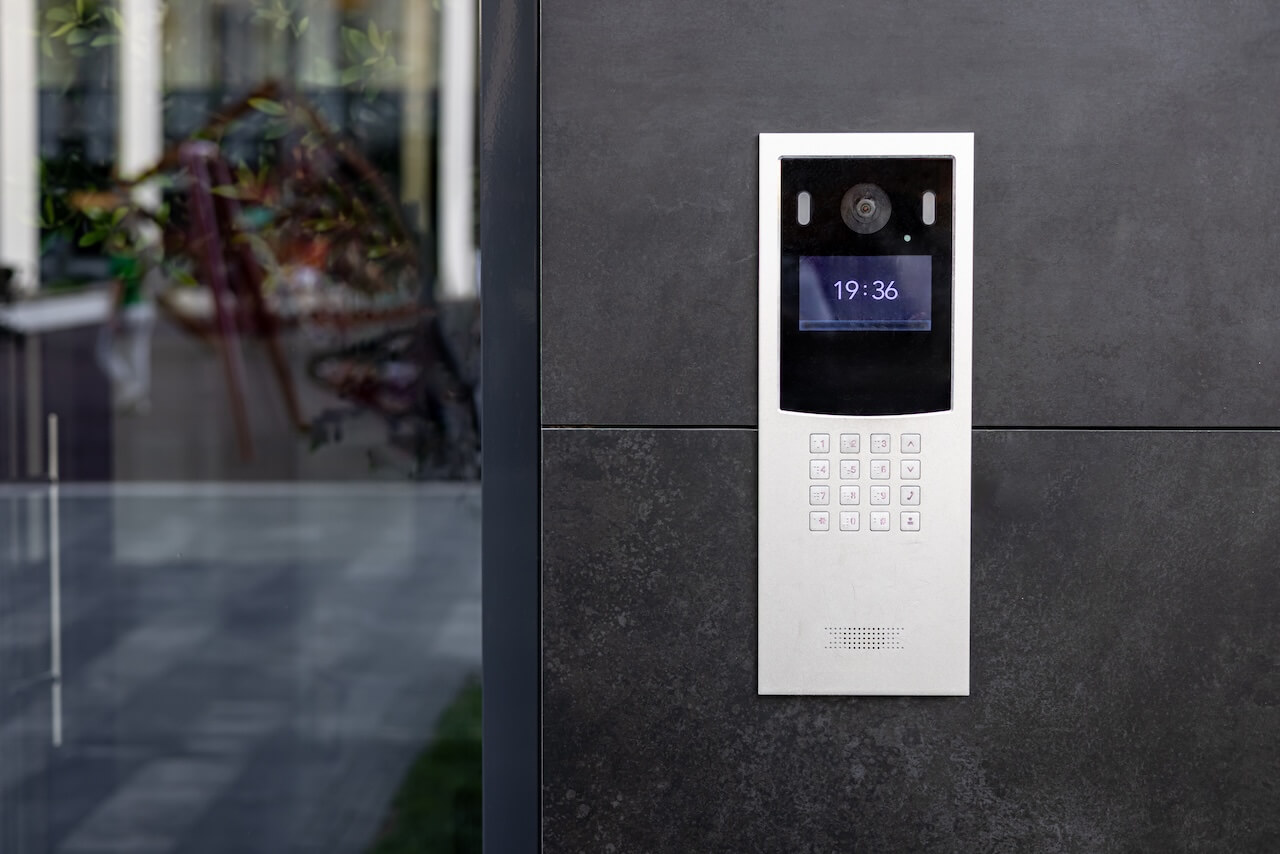
Property managers or owners often manage multiple properties across a portfolio. With numerous tasks lined up, they need tools or systems to make management easier or more seamless. Here’s how deploying an SIP intercom system can help.
An SIP intercom system is a type of wireless IP intercom that can be easily integrated into a property with existing VoIP systems, such as desk phones. It can also work without Internet connectivity as long as a Local Area Network is available, and property managers and owners don’t have to worry about monthly software subscription fees.
Swiftlane works with property managers and building operators across multifamily and commercial properties. The guidance in this article reflects real deployment scenarios, common operator questions, and the trade-offs that come up most often when evaluating SIP intercom options.
Key Takeaways
- An SIP intercom is a type of wireless IP intercom system that uses the Session Initiation Protocol as a communication standard.
- SIP intercom options vary in compatibility, build quality, and PBX support; evaluating these factors helps narrow down the right fit for your building.
- Consider a cloud-based intercom system for better scalability, smoother deployments, and mobile-first operations, compared to SIP-based intercoms.
Table of Contents: Quick Navigation
- What is an SIP Intercom System?
- How an SIP Intercom Works
- Top Options of SIP Intercom Systems
- Cloud-Based Intercoms vs SIP Intercoms
- Best Alternative to SIP Intercom
What is an SIP Intercom System?
An SIP intercom system is a specific type of intercom that uses Session Initiation Protocol (SIP) as its communication standard. SIP is an open signaling protocol that allows initiation, management, and termination of real-time communication sessions.
For more information about SIP, see the Internet Engineering Task Force’s RFC 3261.
An SIP intercom usually consists of a main intercom device at a building entrance, connected to the Internet via Ethernet or Wi-Fi.
It also requires a Private Branch Exchange (PBX), which acts as the system’s brain and can be hosted on an on-premises server, a PBX appliance, or a cloud PBX. As SIP and cloud-based intercoms become more popular, residents receive calls on VoIP phones, video IP phones, softphone applications, or mobile applications rather than an in-unit system.
Benefits
- Integration-Ready. Because of its communication protocol, an SIP intercom system integrates easily with other third-party VoIP systems, such as VoIP deskphones or VoIP softphones
- Offline Capabilities. SIP intercoms can work without Internet connectivity as long as they connect to a Local Area Network.
- No Recurring Subscription Fees. With on-premises PBX hardware, property managers or owners are not charged monthly per-door or per-user software subscription fees.
Limitations
- Deep IT Expertise Required. Because of its communication protocol, an SIP intercom also requires knowledge of SIP, networking, and PBX administration for installation and daily operations.
- Extra Upfront Costs. Because SIP intercoms require a PBX, property administrators need to budget for either purchasing PBX hardware or subscribing to an online PBX service.
- No Out-of-the-Box Portal. Managing SIP intercoms requires configuring the PBX, and to do so remotely, a VPN or remote access setup is required.
How an SIP Intercom Works
- A visitor approaches the SIP intercom and presses the resident call button, sending an SIP INVITE request to the PBX.
- The PBX determines who should receive the call and rings their phone.
- The resident picks up the call, verifies the visitor’s identity, and sends a DTMF tone (usually # or *) through the active call.
- The tone signals the door locks to open, granting the visitor access.
- The resident ends the call, sending an SIP BYE message to the PBX to close the call session.
Top SIP Intercom System Options
The options below represent SIP intercom manufacturers with established compatibility across major PBX platforms. Each has distinct strengths depending on your building’s infrastructure, budget, and integration requirements.
Akuvox


Akuvox is a SIP-focused intercom manufacturer with a broad lineup of devices ranging from audio-only to video-enabled. Its products are built around open SIP standards, making them compatible with major PBX platforms including Asterisk, FreePBX, 3CX, and Grandstream UCM.
Features
- Video + audio calling with HD video support
- Built-in RFID reader for card-based access
- Wiegand compatibility for third-party access control readers
- IP65 (weather resistance) and IK10 (vandal resistance) ratings
- OSDP and ONVIF compatibility for broader system integration
- Compatibility with major PBX platforms: Asterisk, FreePBX, 3CX, and Grandstream UCM
Drawbacks
- Cloud management features require Akuvox’s SmartPlus platform, which adds subscription costs
- Firmware and configuration can be complex without SIP expertise
- After-sales support and documentation quality vary by region
Fanvil


Fanvil is a Chinese intercom manufacturer, with audio-only to video-enabled intercom options. However, instead of offering its own proprietary dedicated PBX server, Fanvil partners with PBX providers such as PortSIP, 3CX, and others.
Features
- Compact form factor of intercom selection
- Built-in RFID (Radio Frequency Identification) reader for card-based access
- Wiegand compatibility for third-party access control readers
- Compatibility for major PBX platforms: FreePBX, Asterisk, 3CX, and Grandstream UCM
- Lowest entry cost compared to other leading intercom manufacturers
Drawbacks
- Lower-grade materials as a tradeoff for lower hardware costs
- IK07 impact resistance rating on some units, lower than the competitors’ IK08-IK10 range
- Low audio and video quality and occasional high latency
Cloud-Based Intercoms vs SIP Intercoms
The closest point of comparison of an SIP intercom is a cloud-based intercom. Both types of wireless IP intercoms can connect to the Internet. However, they differ in how they facilitate communication, the hardware they require, and their long-term pricing.


Best Alternative to SIP Intercom


Swiftlane offers end-to-end intercom solutions at bundled pricing for better affordability without compromising the quality of its products and services. Its cloud-based video intercom systems are highly scalable across multiple locations and centrally managed through the property manager’s web dashboard or mobile application.
Features
- Stable peer-to-peer video calling from intercom device to resident smartphone
- Mobile-first design for plug-and-play deployments
- Intercom offerings suitable for small to large-scale properties
- All-in-one pricing scheme for affordability and predictability
- High-grade intercom materials with IP65 and IK10 ratings
- High audio and video quality with low latency through Power over Ethernet connectivity
- Remote software updates by the technical support team
SIP intercom systems are viable wireless IP intercom choices for VoIP integration and subscription-free operations. However, SIP deployments usually favor properties with existing VoIP infrastructure, such as desk phones and soft phones.
Overall costs fall when in-unit VoIP devices are already in place, but property managers or owners of new construction still have to pay for all other hardware, such as the PBX, resident phones, LAN connections, and so on.
For properties without existing infrastructure, cloud-based intercoms are more cost-effective, easier to install, and faster to deploy thanks to their plug-and-play approach. Still highly scalable with built-in centralized management, cloud intercoms result in more reasonable long-term costs.
Sign up for a live demonstration of Swiftlane, or get instant pricing here.