

Garden-style apartments, sometimes called garden apartments, are among the most common rental housing types in the United States, yet the term confuses many people searching for their next home. Are they ground-floor units? A specific architectural style? A suburban thing? And is a garden-style condo the same thing, just owned instead of rented?
This guide answers all of that. We cover the definition, the pros and cons, real costs, how garden-style apartments compare to mid-rise and high-rise communities, what to know about security, and a breakdown of common features and amenities.
Whether you are a renter trying to figure out if this type of community is the right fit or a property manager evaluating how to run one more efficiently, this is written for you.
Key Takeaways
- Garden-style apartments are low-rise communities, typically one to three stories, with multiple buildings across a landscaped site, exterior entrances, and surface parking. The term describes a property type, not a unit feature.
- Garden level and garden style are not the same thing. The garden level is a unit position. Garden style is a building and site format.
- Best suited for renters who prioritize outdoor space, easier parking, and lower rent over urban amenities and high-rise convenience.
- Main tradeoffs: ground-floor privacy, site spread, and fewer amenities than high-rise buildings.
- Security works differently on a distributed site. Multiple exterior entrances require a more deliberate approach to access control and visitor management than a single-lobby building.
Table of Contents
- What Is a Garden-Style Apartment?
- Garden Style vs Garden Level Apartments: What Is the Difference?
- Pros of Living in Garden-Style Apartments
- Cons of Living in Garden-Style Apartments
- How Much Do Garden-Style Apartments Cost?
- Garden Style vs Mid-Rise vs High-Rise Apartments
- Common Features and Amenities
- Security Considerations
- Wrapping Up
- Frequently Asked Questions
What Is a Garden-Style Apartment?
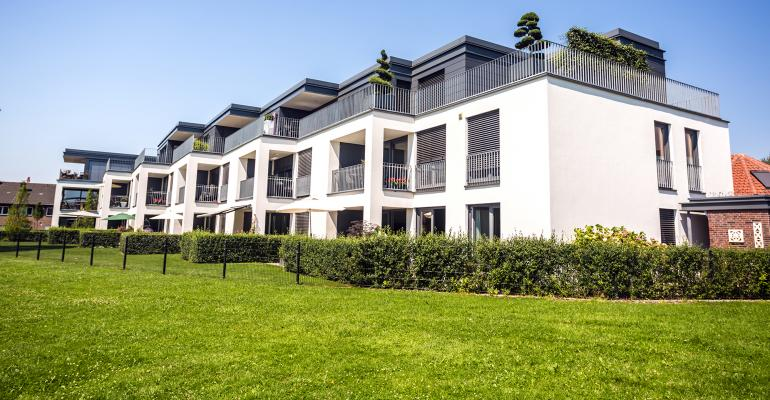
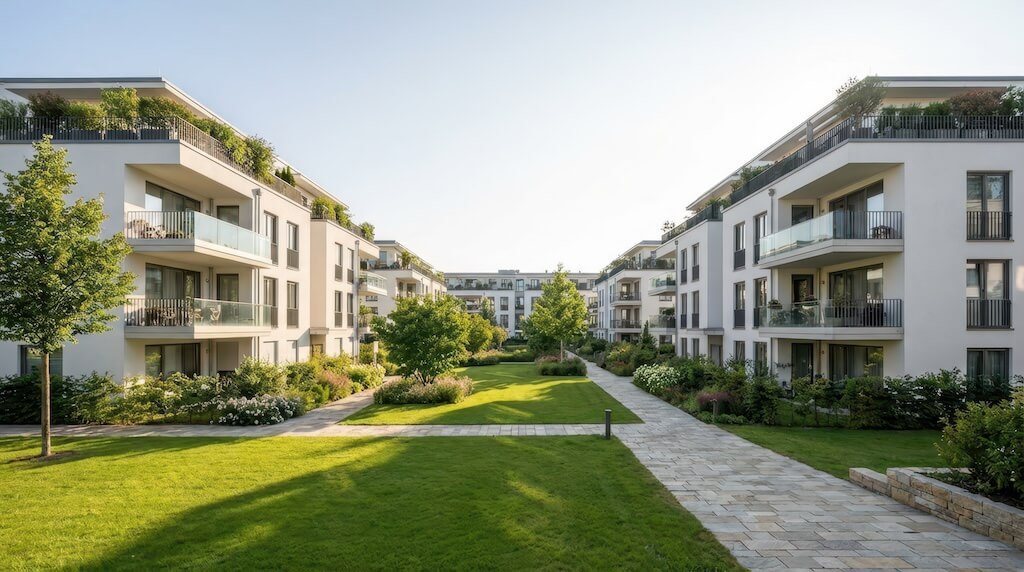
Garden-style apartments are low-rise residential communities, typically one to three stories tall, made up of multiple buildings spread across a landscaped site. Unlike a single high-rise tower, a garden-style property is designed horizontally. Buildings are distributed across the grounds, often arranged around courtyards, green spaces, or walking paths.
Most garden-style apartments have exterior-facing entrances, meaning residents walk outside to reach their unit rather than through an interior corridor. Stairwells are typically open-air or semi-enclosed. Surface parking lots or carports sit close to the buildings, making it easy to park near your front door.
The term “garden style” refers to the property type and site layout, not a specific unit feature. The greenery and open grounds define the category.
What Does a Garden-Style Apartment Community Look Like?
The layout varies, but two configurations are most common:
- Three-story walk-up buildings arranged around a central courtyard, with surface parking on the perimeter and shared amenities like a pool or grill area in the middle
- Clusters of low-rise buildings connected by exterior breezeways or open walkways, spread across a larger site with grass, trees, and landscaped paths between them
- Both configurations share the same defining traits: low height, outdoor access, distributed buildings, and green space as part of the living environment.
- Garden-style communities are most common in suburban areas, though they also appear in smaller cities and on the outskirts of larger metro areas where land costs allow for lower-density development.
Garden Style vs Garden Level Apartments: What Is the Difference?


These two terms get mixed up constantly, and it is worth clearing up before going further.
Garden style refers to the overall property type. It describes the site layout, low-rise building form, exterior entrances, and landscaped grounds. A garden-style community can have units on the first, second, or third floor.
Garden level refers to a specific unit position within a building. A garden-level apartment sits at or slightly below ground level, often with windows that look out onto the ground or into a landscaped area. You will find garden-level units in all kinds of buildings, including mid-rise and high-rise properties.
The short version:
- Garden style = a property and building type
- Garden level = a unit floor position, often ground or basement level
- A garden-style community can contain garden-level units, but the two terms describe different things
- A garden-level unit does not mean the building is garden-style
If you are searching for apartments and see both terms, check what is actually being described. A garden-level unit in a high-rise building is very different from a ground-floor unit in a garden-style walk-up community.
Pros of Living in Garden-Style Apartments


Garden-style communities offer distinct advantages that come directly from the format: low-rise buildings, exterior entrances, and a distributed, landscaped site. Here is what tends to work well.
Direct Outdoor Access from Every Unit
Because garden-style buildings use exterior entrances rather than interior corridors, every unit opens straight to the outdoors, not just the ground floor. That is a structural feature of the format, not a lucky layout, and it is also what makes these communities genuinely convenient for pet owners: getting outside never requires an elevator, a long hallway, or a shared lobby.
No Elevator Dependency
Ground-floor units, at least, come with a guaranteed accessible entrance: federal law requires it. Three stories or fewer does mean no elevator, which is a genuine tradeoff for residents with mobility needs (see Accessibility below), but it also means no waiting on a shared elevator and no risk of it breaking down, a real plus for anyone on the ground floor or simply short on patience.
Surface Parking Steps from Your Door
Because units are spread across low-rise buildings rather than stacked into one tower, garden-style sites use surface lots or carports positioned close to each building instead of a centralized garage. The result is parking that stays close to your unit, regardless of which floor or wing you land in.
Fewer Shared Walls, By Design
The same low-rise, multi-building layout that spreads out parking also means fewer units share a single structure. Depending on the building’s configuration, this can mean fewer adjoining walls and ceilings than a comparable stacked high-rise, reducing noise exposure.
Lower Land-Cost Rent in Most Markets
Garden-style communities require more land per unit than a high-rise, which is exactly why they cluster in suburban and lower-density areas where land is cheaper. That land-cost structure is what typically keeps rents more competitive than an urban high-rise of similar quality, not simply market positioning.
A Landscaped, Multi-Building Site
The courtyards, walking paths, and green space are not an amenity add-on: they are what “garden” in garden-style actually refers to, a site designed around outdoor common space between buildings rather than a single structure with interior halls.
Cons of Living in Garden-Style Apartments


No apartment type fits everyone perfectly. Garden-style communities come with trade-offs that are worth understanding before signing a lease.
Ground-Floor Units Have Lower Privacy
Ground-level units sit close to walkways, parking lots, and common areas. Foot traffic passes near windows, and passersby can see into units more easily than in elevated apartments. Window treatments help, but the exposure is real.
Spread-Out Sites Mean Longer Walks
On a large garden-style property, your unit could be far from the leasing office, mailboxes, amenity areas, or the nearest parking spot. This is rarely a problem in good weather but becomes more noticeable in bad weather when you have to cover that distance on foot.
Ground-Floor Entry Points Warrant a Closer Look
Ground-floor units with exterior entry points are generally easier to access than upper-floor units in a secured building, which is worth factoring into your evaluation of any specific property. In practice, how much this matters depends more on the property’s lighting, entry hardware, and overall security setup than on the format itself.
Fewer Amenities than High-Rise Buildings in Many Cases
Large urban high-rises often subsidize extensive amenity packages through higher rents and density. Garden-style communities vary widely, and smaller or older properties may offer little beyond a pool or a laundry room.
Humidity and Pest Exposure Can Be Higher
Ground-level living near landscaping and soil means greater exposure to moisture, insects, and occasional rodent issues, depending on the region and how well the property is maintained.
Less Natural Light in Some Units
Trees, shrubs, and neighboring buildings can block light to lower-floor units. North-facing ground-floor apartments in particular can feel dim, especially in the winter months.
Higher Heating Costs in Colder Climates
Ground-floor units lose heat through the floor and are more exposed to cold air than upper-floor apartments. In colder regions, this can translate to meaningfully higher utility bills in winter.
No Doorman or Front Desk
Garden-style communities rarely have staffed entry points. If you value that layer of security or the convenience of package handling at a front desk, most garden-style properties will not offer it.
How Much Do Garden-Style Apartments Cost?
Rent
Garden-style rents typically run below mid-rise and high-rise rates in the same market, largely because garden-style communities are concentrated in lower-density, suburban locations where land and construction costs are lower. The gap narrows or disappears in markets where garden-style inventory is scarce or where the property is newer and amenity-rich.
Renters comparing options should weigh price against the tradeoffs already covered above (privacy, amenities, site size) rather than treating garden-style as automatically the cheaper choice everywhere.
Heating and Cooling
Ground-floor and end units in garden-style buildings are more exposed to outdoor temperature swings than interior or upper-floor units in a mid-rise or high-rise, which can mean higher heating costs in cold climates and higher cooling costs in hot ones.
The size of that gap depends heavily on the building’s age, insulation, and local climate, so it’s worth asking a property directly about typical utility costs rather than assuming a fixed premium.
Property Management Operating Costs
For property managers, a garden-style site usually costs more to operate per door than a single-lobby high-rise, mainly because of the distributed footprint: more exterior doors and stairwells to maintain and secure, more landscaping, and more ground to cover for maintenance and patrol.
A high-rise concentrates those same functions into one structure, which is generally more efficient to staff and monitor. This is one reason access control and visitor management tend to matter more, not less, on a garden-style site, a theme covered in the Security section below.
Garden Style vs Mid-Rise vs High-Rise Apartments
The three most common apartment building types differ in more than just height. Here is how they compare across the factors that matter most to renters and property operators.
| Garden Style | Mid-Rise | High-Rise | |
| Height | 1-3 stories | 4-6 stories | 7+ stories |
| Location | Suburban, smaller cities | Suburban and urban | Dense urban core |
| Entrances | Multiple exterior building doors | Single or few lobby entrances | Single-controlled lobby |
| Elevator | No | Yes | Yes |
| Parking | Surface lots, close to units | Surface or structured, varies | Garage, often with an extra cost |
| Amenities | Pool, courtyard, grilling area | Varies, often more than a garden | Extensive, concierge common |
| Rent | Generally lower | Mid-range | Generally higher |
| Pet friendliness | High, direct outdoor access | Moderate | Lower, elevator-dependent |
| Security model | Distributed, multiple entry points | Mixed | Centralized lobby control |
Garden-style communities are the most spread out of the three types, which shapes daily life in practical ways. No elevator means no waiting and no dependency, but also no option for residents with mobility limitations. Surface parking close to your unit is convenient, but a large site means some units are farther from amenities than others.
The centralized security model of a high-rise is simpler to manage but comes with higher density and urban pricing.
Common Features and Amenities
Many of today’s garden-style apartments were built during the postwar suburban boom, from the 1950s through the 1980s, when low-rise, low-density development expanded rapidly across suburban America. NMHC’s tabulations of Census data show roughly 48% of all US apartment units (not garden-style specifically) were built between 1960 and 1999, a period that overlaps heavily with garden-style’s biggest construction era.
That vintage matters for what to expect on a tour. Older construction is where several patterns in this guide connect: in-unit laundry is less guaranteed, package lockers are often absent, insulation and window seals tend to be weaker (tying into the heating and cooling costs above), and closets and plumbing runs are frequently smaller or dated compared to anything built in the last two decades.
None of this is universal, since plenty of garden-style communities have been renovated or built more recently, but it’s a concrete, useful question for a renter to ask directly: when was this property built, and what’s been updated since?
Features vary by property age, market, and management quality, but the following gives a reliable picture of what to expect.
| Feature / Amenity | How Common | Notes |
| Surface parking or carports | Very common | Usually close to buildings; dedicated spots vary by property |
| Courtyards and green space | Very common | Central to the garden style format; quality and maintenance vary |
| Outdoor walking paths | Common | More prevalent on larger sites |
| Swimming pool | Common | Standard in most mid-size and larger garden-style properties |
| Outdoor grilling / BBQ areas | Common | Often paired with pool or courtyard areas |
| Playground | Common | Especially in family-oriented suburban communities |
| On-site laundry rooms | Common | In-unit laundry is less guaranteed than in newer high-rise buildings |
| Exterior lighting | Common | Quality and coverage vary significantly by property |
| Gated entry | Varies | More common in newer or higher-end garden-style communities |
| Fitness center | Varies | Less universal than in high-rise buildings |
| Package lockers | Varies | Increasingly common in newer builds; older properties often lack them |
| Doorman / front desk | Rare | Not a standard feature of the garden-style format |
| Concierge services | Rare | Uncommon outside of luxury-tier garden-style properties |
Security Considerations
Garden-style communities call for a different security approach than a single-lobby high-rise, simply because of the site layout. Multiple buildings, each with its own exterior doors, mean there’s no single point where all traffic naturally funnels through. That doesn’t make garden-style less safe on its own, but it does mean security has to be built deliberately across the site rather than concentrated in one lobby.
Here’s what that looks like in practice, for renters evaluating a property and for the people managing one.
Are garden-style apartments safe?
Safety depends on the specific property and how it is managed, not on the garden-style format itself. Structurally, garden-style communities have more exterior entry points than a single-lobby high-rise, since each building has its own doors and stairwells. That distributed layout means security depends more on how well those individual entry points are controlled, lit, and monitored, and less on a single front desk or lobby doing the work.
A well-managed garden-style property with controlled entry and good lighting can be just as secure as a high-rise; the difference is in how deliberately that security has to be built, since it isn’t concentrated in one place by default.
For a broader overview of how access control works in residential buildings, the apartment security systems guide is a useful starting point.
The Core Challenge: Distributed Entry Points
A high-rise funnels all traffic through one or two controlled lobby entrances. A garden-style property does the opposite. Multiple buildings, each with its own exterior doors and stairwells, mean far more entry points to manage across the site. A property with eight buildings might have sixteen or more exterior doors to secure and monitor.
What Renters Should Look For
- Exterior lighting across walkways, parking areas, and building entrances
- Controlled building entry that requires a credential rather than a propped or unlocked door
- A clear visitor and delivery access process
- Package lockers or a staffed receiving option, since there is no front desk
Managing a Garden-Style Community
For property managers, the distributed layout is the whole ballgame. Multiple exterior doors, no central lobby, and no doorman mean you have to build the security model deliberately rather than inherit it from the building’s architecture. A few areas to prioritize:
- Multiple exterior doors. Key fob systems and other keyless entry options let you manage every door on the site from a single platform, using mobile credentials or key cards instead of physical keys that are easy to lose track of across a spread-out property.
- Visitor and delivery access. A video intercom system lets residents see and speak with visitors and remotely unlock the door from their phone, which matters more on a garden-style site precisely because there’s no front desk to hand off that job to.
- Maintenance and vendor access. Cloud-based door access control lets managers assign access by person, building, and time window, with audit logs available when needed, which is harder to do consistently with physical keys across multiple buildings.
- Unit turnover. Mobile access control eliminates rekeying entirely. Access is granted and revoked digitally, which saves significant time on a property with many buildings and doors compared to rekeying physical locks one by one.
Wrapping Up
Garden-style apartments are a practical, often affordable option for renters who prioritize outdoor space, easier parking, and a quieter residential atmosphere over the amenities and density of urban high-rise living. Costs typically run lower than mid-rise and high-rise properties in the same market, though the gap depends on the site, its age, and local demand. Ground-floor privacy, site spread, and fewer on-site amenities are real trade-offs worth weighing before signing a lease.
For property managers and owners, the distributed layout that defines garden-style communities requires a different approach to access control and visitor management than a single-lobby building. The more entry points across a site, the more important it is to have systems that are easy to manage remotely, easy for residents to use, and easy to audit when something goes wrong.
If you manage a garden-style community and are evaluating access control or intercom options, Swiftlane specializes in multifamily properties and can simplify the process. You can get a quote or book a demo to see how it fits your site.
Frequently Asked Questions
What is a garden-style apartment?
A garden-style apartment, sometimes called a garden apartment, is a low-rise residential community, typically one to three stories, composed of multiple buildings spread across a landscaped site, with exterior entrances and surface parking.
What is the difference between a garden style and a garden-level apartment?
Garden style refers to the property type and site layout. Garden level refers to a specific unit position, usually at or slightly below ground level. A garden-style community can contain garden-level units, but the terms describe different things.
What is the opposite of a garden-style apartment?
A high-rise apartment is generally considered the opposite of garden style. High-rises are tall, single-building structures with a centralized lobby entrance, elevators, and units stacked vertically rather than spread across a landscaped, low-rise site.
What is a garden unit apartment?
“Garden unit” usually refers to a garden-level unit within a building, one positioned at or slightly below ground level, rather than a garden-style property as a whole. The terminology overlaps with garden-level apartments and is used similarly across listings.
What is a garden-style apartment complex?
A garden-style apartment complex is the property itself: a group of low-rise buildings, typically one to three stories, arranged around shared courtyards, green space, or walking paths, with surface parking and exterior entrances to each unit. The same low-rise, multi-building format also appears in garden-style condo developments, where units are owned rather than rented, so the term describes a building and site format that isn’t exclusive to rental housing.
Are garden-style apartments cheaper?
Generally, yes, particularly when compared to urban high-rise buildings. Garden-style communities are predominantly suburban and lower-density, which typically supports lower rents. Pricing varies by market and property quality.
Do garden-style apartments have elevators?
Rarely. Most garden-style buildings are three stories or fewer and rely solely on stairs. If you need elevator access, a mid-rise or high-rise building is a better fit.
What is the difference between garden-style and mid-rise apartments?
Mid-rise buildings are four to six stories tall, are found in both suburban and urban settings, and typically offer more amenities and elevator access. Garden-style communities are lower-density, more suburban, and rely on exterior staircases and surface parking.
Are garden-style apartments safe?
Safety depends on the specific property and how it is managed. Garden-style communities have more exterior entry points than a single-lobby high-rise, which is worth factoring into your evaluation. Look for controlled building entry, good exterior lighting, and a clear visitor access process.
Are garden-style apartments good for pets?
Yes, in most cases. Direct outdoor access from ground-floor units and on-site green space make garden-style communities a practical choice for pet owners.
How We Researched This
This guide was built from a review of current search results and definitions from reputable sources in housing, property management, and real estate. We cross-referenced how the terms “garden style,” “garden level,” and related phrases are used in industry contexts to ensure the definitions here reflect standard usage rather than a single source.
A few data points worth noting:
- Garden-style and low-rise apartment buildings represent the largest share of the US rental housing stock by unit count, accounting for roughly 40% of all multifamily units according to NMHC research on apartment stock composition.
- Suburban rental demand has grown steadily since 2020, driven in part by the flexibility of remote work. According to Harvard’s Joint Center for Housing Studies, suburban and small metro rental markets have absorbed a significant share of household formation over the past several years.
- The US Census Bureau’s American Housing Survey tracks rental-unit characteristics, including building type and height, and is the primary source of national data on low-rise versus high-rise housing stock.
Features, amenities, and security considerations reflect common patterns across garden-style communities rather than any single property or market. Specifics vary by region, property age, and management quality, and we have tried to flag that where relevant rather than presenting any single characteristic as universal.
If you manage or develop multifamily properties and believe something here should be updated or clarified, we welcome the feedback.


