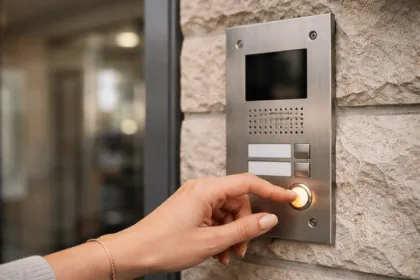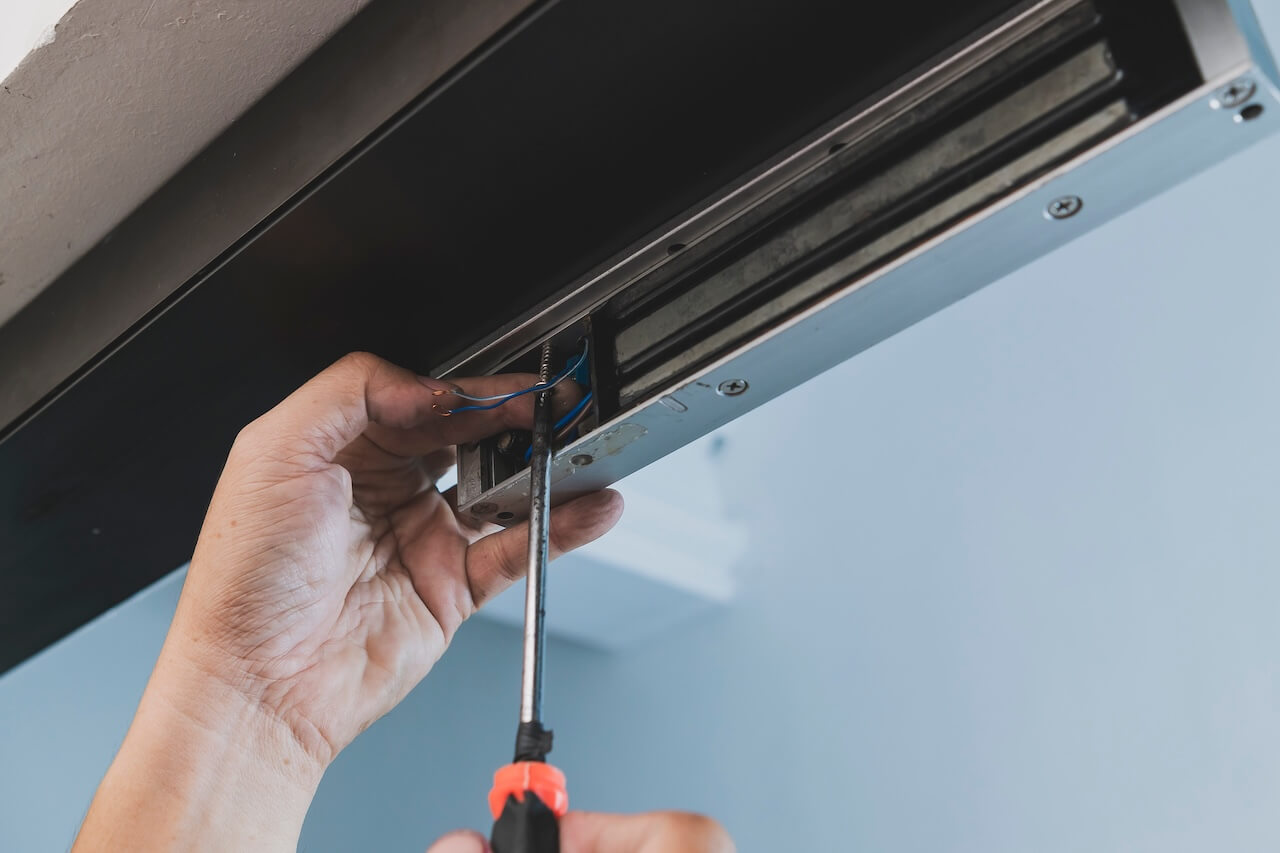
An apartment intercom system with door release combines two-way audio or video communication with an electrified door lock. Residents verify a visitor at the building entrance, then trigger a signal that releases an electric strike or magnetic lock, unlocking the door remotely without anyone leaving their unit.
How We Evaluated This Guide
This guide draws on Swiftlane’s experience deploying intercom and access control systems in multifamily buildings, cross-referenced with building and fire code requirements for electrified locking and manufacturer documentation for door-release hardware. Cost guidance focuses on installation complexity rather than fixed pricing, since actual costs depend on building condition, existing wiring, and local labor rates.
Key Takeaways
- An apartment intercom system with door release pairs visitor verification (audio or video) with an electrified lock, an electric strike or a magnetic lock, that opens remotely.
- Electric strikes are typically fail-secure (locked on power loss); magnetic locks are fail-safe (unlocked on power loss) and require a battery backup to hold security during an outage.
- Any electrified lock on an egress door must be coordinated with the local Authority Having Jurisdiction and fire marshal, including a Request-to-Exit sensor and a fire alarm panel interlock where a maglock is used.
- Modern cloud-based intercoms route calls to a resident’s smartphone, eliminating the need to wire in-unit panels.
- Installation cost scales with complexity (existing hardware and conduit vs. a full retrofit) rather than a single per-unit price.
Table of Contents
- How Door Release Works: Electric Strikes vs. Magnetic Locks
- Life-Safety Code Coordination & AHJ Oversight
- Types of Apartment Intercom Systems: Architectural Comparison
- Matching Door Release Intercoms to Residential Environments
- Planning Your Installation: Retrofit vs. New Construction
- Why Choose Swiftlane
- FAQs
How Door Release Works: Electric Strikes vs. Magnetic Locks
Every intercom with door release routes its unlock signal through a Form C dry contact relay with three terminals: Normally Open (NO), Normally Closed (NC), and Common (COM). Which pair of terminals the lock is wired to determines how the door behaves when power is lost, and that choice is what separates an electric strike from a magnetic lock.
- Electric strikes are wired across NO and COM. The circuit sits open and unpowered by default, so the door stays locked. When the intercom sends an unlock command, the relay closes, sending 12V or 24V DC to the strike’s solenoid and releasing the keeper.
- Magnetic locks are wired across NC and COM. The circuit is closed by default, holding continuous power to the electromagnet and keeping the door locked. When an unlock command is sent, the relay opens, cuts power, and drops the magnetic hold.
That wiring difference is also why the two devices need different kickback protection. Strike solenoids and maglock coils both store energy in a magnetic field, and when the relay cuts power to that field, the field’s collapse generates a voltage spike that can reach hundreds of volts. Left unprotected, that spike can arc across the relay contacts and weld them shut, or damage the intercom’s control board.
A reverse-biased diode (a 1N4004 is a common choice) across DC lock terminals, or a metal oxide varistor across AC terminals, clamps the spike at the lock instead of letting it reach the relay.
Electric Strikes: The Standard for Fail-Secure Perimeter Doors
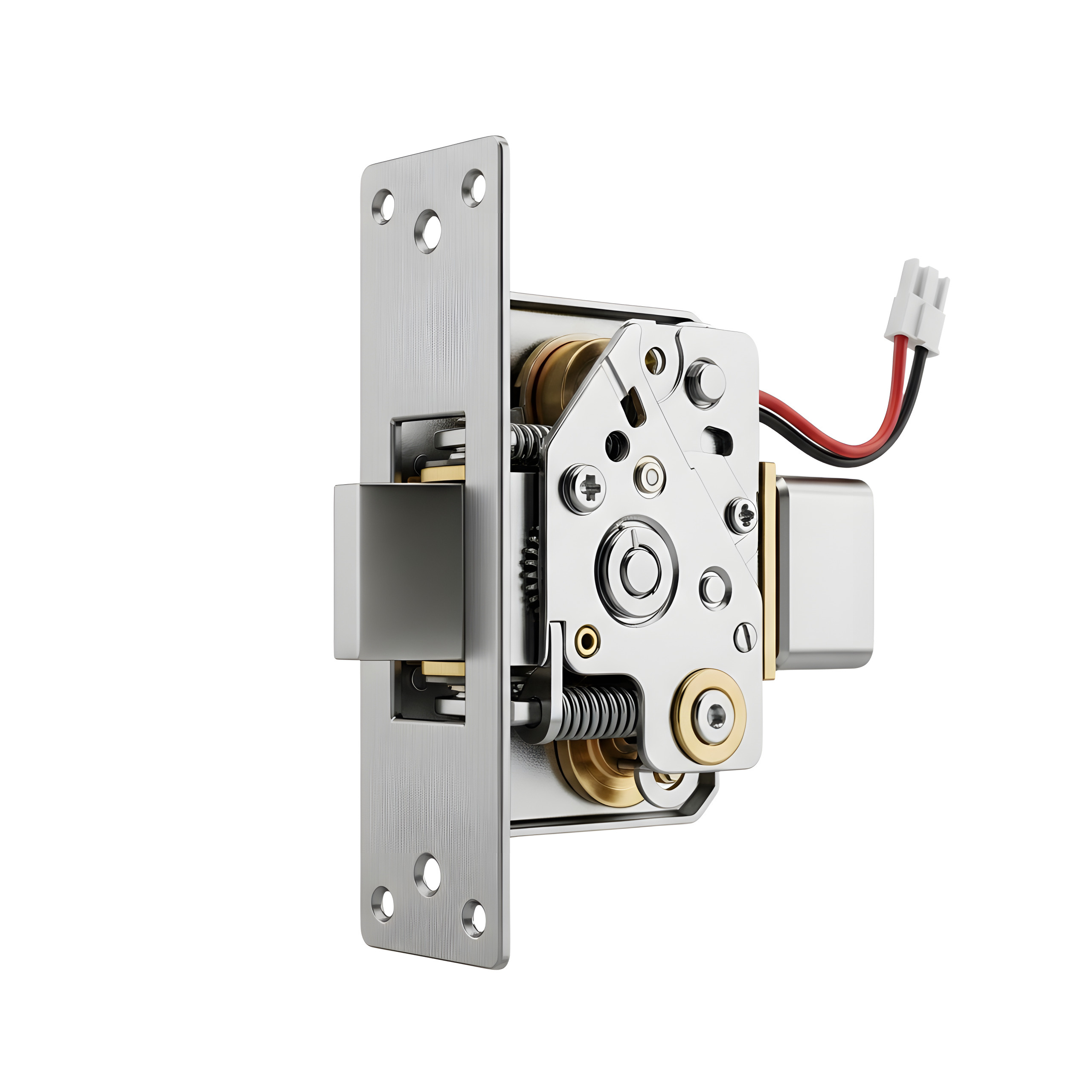
An electric strike releases the keeper while the door’s mechanical latch stays extended, so the door never becomes physically unlocked the way a deadbolt would. This is a fail-secure device: on power loss, the strike returns to its locked state and stays that way. Because the interior lever or panic bar still operates mechanically regardless of power, occupants can always exit, even during an outage.
That combination, secure by default and always exitable from inside, is why electric strikes are the standard choice for building perimeter doors.
Magnetic Locks: When and How to Use Fail-Safe Electromagnetic Locking
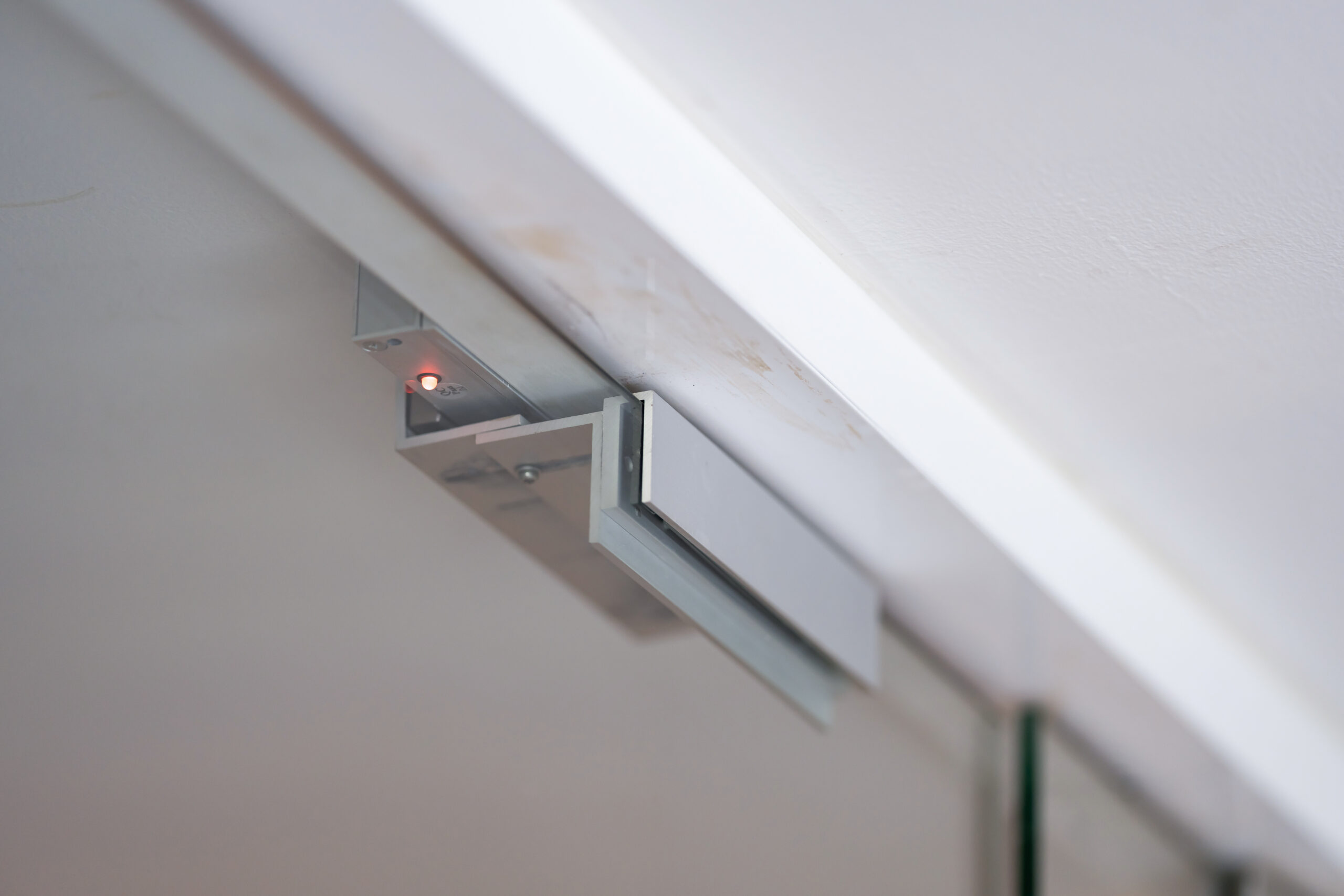
A magnetic lock holds the door shut with direct magnetic force, typically 600 to 1,200 pounds, against a steel armature plate mounted on the door. Because that holding force depends entirely on continuous power, a maglock is fail-safe by design: cut the power and the door unlocks.
That makes battery backup non-negotiable. Without it, a utility brownout or breaker trip unlocks every maglocked door in the building at once. It also means a maglock on an egress door triggers a specific set of code requirements, covered next.
Life-Safety Code Coordination & AHJ Oversight
Any electrified lock on an egress door is a life-safety decision before it’s a security one. The primary rule, ahead of every other detail in this section, is that the local Authority Having Jurisdiction and fire marshal govern what’s allowed on a given door. Model codes set the baseline, but local adoption and interpretation vary, so a design that’s compliant on paper still needs sign-off from whoever inspects it.
Where a magnetic lock secures an egress door, both the IBC and NFPA 101’s sensor-release provisions for electrically locked egress doors require three coordinated release mechanisms, since a maglock’s fail-safe design alone isn’t considered a reliable path to egress:
- A motion or PIR Request-to-Exit (REX) sensor on the egress side, arranged to detect an approaching occupant and unlock the door automatically before they reach it.
- A manual “PUSH TO EXIT” button, mounted 40 to 48 inches above the floor and within 5 feet of the secured door, that directly interrupts power to the lock, independent of the access control electronics, and keeps the door unlocked for at least 30 seconds.
- A Fire Alarm Control Panel (FACP) interlock, so the lock releases automatically on fire alarm or sprinkler activation and stays unlocked until the system is reset.
Electric strikes on non-egress or fail-secure-permitted doors don’t carry this same three-part requirement, since the mechanical latch already provides free egress regardless of power state. But any wiring for either device should also follow NFPA 70’s Class 2 power-limited circuit rules, which cap voltage and current on the low-voltage side and matter most on longer wire runs where voltage drop can leave a lock underpowered.
None of this replaces a site-specific review. Building type, occupancy classification, and the specific code edition a jurisdiction has adopted all affect what’s required, so confirm the exact requirements with the local AHJ before finalizing hardware; this is necessary, not optional.
Types of Apartment Intercom Systems: Architectural Comparison
Every apartment intercom system with door release fits into one of four architecture classes, and the class determines what wiring exists at the door, what residents use to answer, and how the door-release signal gets sent. Picking the right class for a given building matters more than picking a particular vendor within it.
Table 1: 4-Class Architecture Comparison
| Intercom System Class | Door Release Signaling | Resident Answering Hardware | Best Building Profile | Key Operational Advantage |
| Cloud-Based Video Intercom | Cat6 PoE+ to a dry contact relay at the strike or maglock | Smartphone app, tablet, or web browser | Mid-to-high-density multifamily and luxury apartments | Eliminates in-unit wiring; remote door unlock from anywhere |
| Hardwired IP / SIP Intercom | Cat6 or local LAN, SIP PBX relay to the door controller | Dedicated in-unit wall monitors | Senior living, high-security apartments, or offline builds | Functions without a public internet connection |
| Cellular / Telephone Entry System | Cellular LTE gateway, relay trips on a DTMF tone | Resident cell phone or landline, audio only | Garden-style apartments, gated entries, budget retrofits | No internet or unit cabling required |
| Legacy 2-Wire Multi-Tenant Buzzer | Direct low-voltage buzzer circuit over copper riser | In-unit analog talk/listen/door station | Older pre-war walkups | Minimal upfront hardware cost |
1. Cloud-Based Video Intercoms (Modern Standard)
This architecture underpins most new apartment-building entry systems today. The entry panel routes a video call to the resident’s phone over Wi-Fi or cellular, so answering doesn’t depend on being near an in-unit monitor. Beyond the call itself, cloud platforms typically add temporary delivery PINs, a virtual resident directory that updates as leases turn over, and remote door release from anywhere, not just from inside the unit.
For a closer look at how door release specifically works across video intercom deployments outside the apartment context, including commercial and gated industrial sites, see Swiftlane’s video intercom systems with door release guide.
2. IP / SIP Hardwired Systems
IP/SIP systems route calls over the building’s own network rather than the public internet, using a local PBX or SIP server and dedicated in-unit touchscreens instead of a mobile app. That independence from outside connectivity is the main draw for senior living communities, high-security apartment buildings, and offline builds where reliability can’t depend on an ISP.
The tradeoff is hardware cost. In-unit touchscreens and local server infrastructure cost more upfront than a mobile-first cloud deployment, and this architecture also underpins most commercial intercom systems with door release installations, where dedicated network infrastructure is already the norm.
3. Cellular & Telephone Entry Call Boxes
A cellular or telephone entry system dials the resident’s cell phone or landline over PSTN or a cellular network, rather than routing through an app. The resident answers like a normal phone call and presses 9 to send a DTMF tone that trips the door relay. Because there’s no internet dependency and no need to wire individual units, this architecture fits garden-style apartments, gated community entries, and budget-conscious retrofits well.
The main limitation is that it’s audio-only. There’s no video verification of who’s actually at the door.
4. Legacy 2-Wire / Multi-Tenant Analog Buzzers
The oldest of the four classes, a 2-wire buzzer system runs a dedicated copper riser to an in-unit wall station with basic talk, listen, and door-release buttons. It’s still common in older pre-war walkups where that wiring is already in the walls. Upfront hardware cost is low, but there’s no video, no remote access from a resident’s phone, and maintenance tends to climb as the copper wiring and mechanical wall stations age.
Buildings with existing 2-wire infrastructure can often reuse it as the backbone for a cloud upgrade rather than rewiring from scratch, which is a common bridge between this class and the cloud-based option above.
Matching Door Release Intercoms to Residential Environments
The four architecture classes above aren’t interchangeable across every building type. Occupancy pattern, existing infrastructure, and who’s actually responsible for approving hardware changes all narrow the realistic options for a given property.
Multi-Tenant Apartments
Multi-tenant apartment buildings are where cloud-based video intercoms have the clearest advantage. Turnover is constant, so a directory that updates itself as leases change matters more than it does in a condo with long-term owners. Property managers also benefit from centralized administration across a portfolio, provisioning or revoking access for an entire building from one dashboard rather than rekeying hardware at each unit.
For buildings that already have a working 2-wire buzzer riser, the migration path is usually to reuse that existing copper for power and signaling rather than fully rewiring. Swiftlane’s multi-tenant intercom system guide covers that migration path in more depth, including how to sequence the retrofit unit by unit without cutting off access mid-project.
Condos & HOAs
Condo door entry systems follow a different approval path than rental buildings, since condo boards and HOAs answer to owners rather than a single property manager. Purchases typically need board approval and sometimes a resident vote, which favors systems with transparent per-owner costs over portfolio-wide licensing models built for rental operators. Because condo owners are also the ones legally responsible for the building’s common areas, egress compliance tends to get scrutinized more closely here.
Any electrified lock proposal should go to the board with the AHJ coordination already documented, not left for a property manager to sort out after installation.
Mixed-Use Buildings
Mixed-use buildings need to separate the residential intercom from ground-floor retail or office access entirely rather than merging them into one system. Sharing a system creates predictable friction: retail tenants often need business-hours-only access schedules and separate visitor logs, while residential access needs to run 24/7 with a completely different resident directory. Running these as two logically separate deployments, even on shared physical infrastructure, prevents a retail employee from accidentally showing up in a resident’s call list or a delivery courier from being routed to the wrong door group entirely.
Across all three environments, the underlying question is the same: does an apartment intercom system with door release need to serve one property manager, a board of owners, or two entirely separate tenant populations? That answer, more than building age or unit count, is what should drive the architecture choice from Table 1.
Budgeting for an Apartment Intercom System With Door Release
Pricing an apartment intercom system with door release by a flat per-unit or per-building number rarely holds up, because the door hardware, wiring path, and site conditions vary too much from project to project. A more reliable way to scope budget is by installation complexity rather than a fixed price tag.
Table 2: Installation Complexity Tiers
| Complexity Tier | What Drives It | Typical Scope |
| Low (Surface Retrofit) | Functional strike already in place | Entry panel + software only, no cutting or rewiring |
| Moderate (Full Electrification) | No existing electrified lock | Frame cut-in, Cat6 PoE+ home run, battery backup cabinet |
| High (Multi-Door Campus) | Gates, garages, or elevators added | Trenching, garage door integration, elevator lockout relays |
The jump from Low to Moderate is almost always about whether usable electrified hardware already exists at the door. A strike or maglock that’s already wired and functional keeps a project in the Low tier even if the intercom panel itself is being fully replaced. The jump from Moderate to High is about scope rather than difficulty at any single door.
Buildings with vehicle gates, parking garage doors, or elevator access control move into High complexity because each additional access point adds its own wiring run, code compliance check, and integration point, not because any one of them is harder to wire than a single perimeter door. For buildings adding elevator access as part of a broader system, Swiftlane’s elevator access control guide covers how floor-level lockout integrates with the rest of the access control stack.
Because actual costs depend on labor rates, existing conduit, and site-specific code requirements, the most reliable way to get a firm number is a property-specific quote, not a published price list. For a fuller breakdown of what typically drives cost up or down within each tier, see Swiftlane’s apartment intercom cost guide and installation cost guide.
Planning Your Installation: Retrofit vs. New Construction
- Audit existing infrastructure. Retrofits: check for a functional strike or maglock already at the door (this decides Low vs. Moderate complexity) and whether an existing 2-wire riser can be reused. New construction: confirm conduit paths and power runs are specified before drywall goes up.
- Confirm code requirements with the AHJ before ordering hardware. Any egress door getting a maglock needs the REX sensor, push-to-exit button, and FACP interlock sign-off first, so you don’t buy hardware twice.
- Sequence around access gaps. Occupied retrofits should keep the existing system live until you test the new one. New construction has no existing residents to work around.
- Test the full signal chain before handoff. Confirm the call routes, the relay trips the lock, the battery backup holds under a simulated outage, and the REX sensor and push-to-exit button work independently of the access software.
Why Choose Swiftlane
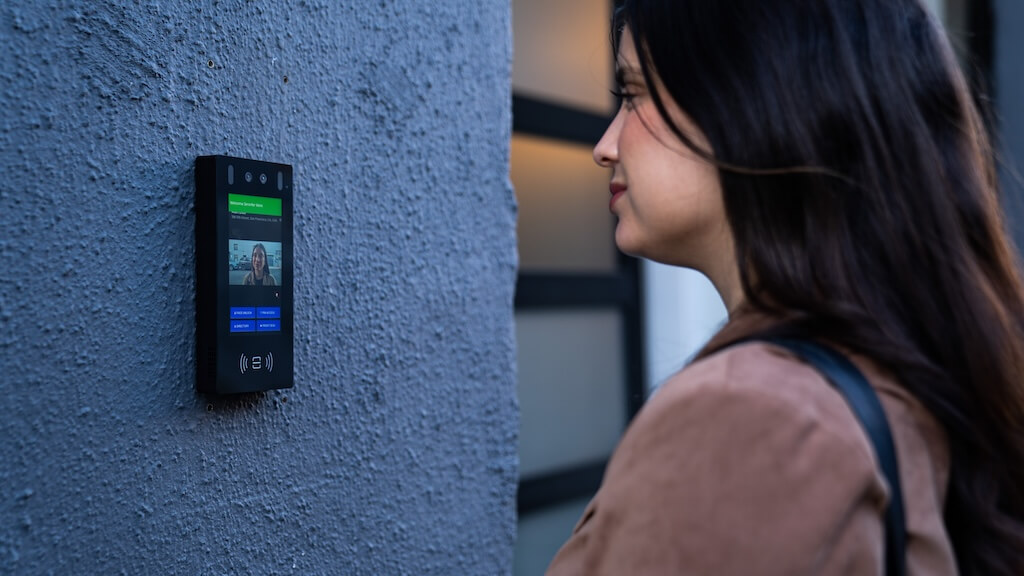
Swiftlane’s video intercom platform is cloud-based, so it fits directly into the architecture class most multifamily buildings are moving toward, as shown in Table 1.
- Mobile-first door release. Residents verify visitors and unlock the door from their phone, from anywhere, not just from an in-unit panel.
- Facial recognition entry for residents. Recognized residents walk in without a fob or key card. Any facial recognition or biometric feature is subject to Illinois BIPA, Texas CUBI, and Washington RCW 19.375 requirements, and Swiftlane’s own compliance approach should be confirmed before this bullet publishes.
- PMS integration. Syncs with property management software so move-ins and move-outs update the resident directory automatically instead of requiring manual entry.
- Delivery and guest PINs. Time-limited codes for couriers and visitors, without permanent credentials that need to be revoked later.
- Offline resilience. Local caching keeps door release working through an internet outage, addressing the single biggest limitation of cloud-based systems in Table 1.
- Elevator and multi-door support. Scales into the High complexity tier from Table 2, tying floor-level access and gates into the same platform rather than a separate system.
For buildings already comparing architecture classes and complexity tiers above, Swiftlane fits the cloud-based video intercom category with the code-compliance groundwork already covered in this guide built in.
See how Swiftlane’s video intercom platform handles door release, visitor management, and code-compliant egress in one system. Schedule a demo to walk through a property-specific quote.
Closing Cluster Links
For related buying guidance, see:
- Multi-Tenant Intercom System Guide
- Apartment Intercom Cost Guide
- Apartment Intercom Installation Cost Guide
- Commercial Intercom System With Door Release
- Video Intercom Systems With Door Release
- Door Access Control Guide
- Elevator Access Control Guide
FAQs
How does the door release mechanism in an apartment intercom system work?
When a resident approves a visitor, the intercom sends an unlock signal to a relay at the door. The relay either closes (for a fail-secure electric strike) or opens (for a fail-safe magnetic lock) to release the door for a set number of seconds, then automatically returns to its default locked state.
What happens to the door if the internet goes out?
It depends on the architecture. Cloud-based video intercoms with local caching can continue processing door-release commands and recognized-resident entry during an outage, since the door controller itself doesn’t need a live internet connection to trigger the relay.
IP/SIP systems running on a local network are unaffected by an internet outage, since they never depend on it. Cellular and legacy 2-wire systems also keep working, since neither relies on internet connectivity in the first place.
What’s the difference between fail-safe and fail-secure locks?
- Fail-secure (electric strikes): the door stays locked if power is lost. The mechanical latch still allows exit from inside.
- Fail-safe (magnetic locks): the door unlocks if power is lost. This is why a battery backup is necessary, not optional, on any maglock installation.
Which type is appropriate for a given door depends on its egress classification and local fire code, covered in the Life-Safety Code Coordination section above.
Can couriers and delivery services unlock the door without a resident?
Yes, through a time-limited PIN or a temporary access code that a resident or property manager issues in advance. The code expires automatically after a set window, so there’s no permanent credential to track down and revoke later.
Can one system also control gates, garages, or elevators?
Yes, though this moves the installation into a higher complexity tier since each additional access point (a vehicle gate, a garage door, an elevator floor lockout) adds its own wiring run and code compliance check. See the Budgeting section above for how that scoping works.
How much does an apartment intercom system with door release cost?
Cost depends on installation complexity, not a fixed per-unit price. A retrofit onto an existing, functional strike costs meaningfully less than a full electrification project with no existing lock hardware, and multi-door or elevator-integrated systems cost more still. See the Budgeting section above for the three complexity tiers, or request a property-specific quote for a firm number.