TL;DR
Choosing an access control installer is about more than finding someone who can install readers and controllers. The right partner should understand your building, existing infrastructure, security requirements, and long-term support needs. We reviewed the top Bay Area access control installers with different strengths and areas of expertise to help property owners narrow their options:
- Elwin Security: Best suited to multifamily, commercial, and mixed-use properties needing access control integrated with doors, locks, gates, cameras, and intercoms across the Bay Area.
- Integrated Access Security: A fit for commercial properties seeking access control alongside video surveillance and broader security-system integration, particularly around Redwood City.
- Metro Electric: A strong option for larger commercial projects where access control needs to be coordinated with electrical, structured cabling, CCTV, and other low-voltage systems.
- PAC Integrations: Best suited to businesses looking for access control as part of a broader, integrated security strategy with remote management and ongoing monitoring.
- AEC Alarms: A practical option for properties that prioritize flexible credentials, including smartphones, proximity cards, and PINs, along with remote door and gate management.
How We Selected These Installers
We selected companies with a documented Bay Area presence and evidence of commercial access control installation or integration. We considered service coverage, commercial or multifamily experience, access control capabilities, related services such as door hardware and intercoms, and ongoing support. Verify licensing and current service availability independently before hiring.
Table of Contents
- What to Look For in a Bay Area Access Control Installer
- Signs of a Good Access Control Installer and Red Flags
- Top 5 Access Control Installers in the Bay Area
- Choosing an Installer Is One Part of the Decision
- FAQs
Related Posts
- Top Access Control Installers in Grand Rapids
- Best Access Control Installers in Dallas-Fort Worth
- Top Access Control Installers in Florida
What to Look For in a Bay Area Access Control Installer
The best access control installer for one building may not be the right choice for another. A 10-door office retrofit, for example, can have very different requirements from a 300-unit apartment property with parking gates, elevators, and multiple entrances.
Before comparing companies, look for these characteristics.
California Licensing and Credentials
Start by verifying that the contractor has the appropriate California license for the work.
The California Contractors State License Board (CSLB) recognizes several contractor classifications relevant to access control projects. C-7 Low Voltage Systems covers certain communication and low-voltage systems, while C-28 Lock and Security Equipment specifically includes card-activated and electronic access control systems. C-10 Electrical may also be relevant when a project involves electrical installation within that classification.
Don’t assume that every access control project requires the same license. Ask the installer which licenses apply to your specific scope and verify the license through CSLB before signing a contract.
If the project involves alarm-system work, additional California Bureau of Security and Investigative Services (BSIS) requirements may apply. BSIS maintains separate licensing for Alarm Company Operators and provides a public license-verification system.
Experience With Commercial and Multifamily Properties
Look for an installer that regularly works with the type of building you operate.
Commercial access control can involve employee credentials, tenant permissions, visitor access, restricted areas, elevators, vehicle access/parking, and multiple sites.
Multifamily properties may add resident move-ins and move-outs, package deliveries, amenity spaces, garages, and shared entrances.
Experience With Modern and Legacy Systems
A good installer should be able to work with the building you have, not just the system they want to sell.
Ask whether they can assess existing readers, locks, controllers, wiring, power supplies, and door hardware. If you’re upgrading a legacy system, determine which components can remain and which need replacement.
Integration Capabilities
Access control rarely operates in isolation. Depending on the property, the installer may need to coordinate access with video surveillance, video intercoms, door hardware, gates, elevators, or other low-voltage systems.
An integrator that can handle multiple layers can simplify project coordination and troubleshooting.
Post-Installation Support
Ask what happens after the installer leaves.
Credential changes, failed access control readers, door alignment problems, wiring issues, power failures, and system configuration questions can all arise months or years after commissioning. A company that offers maintenance and service can be more valuable than one that only handles the initial installation.
Signs of a Good Access Control Installer and Red Flags
The installation process can tell you a lot about how a company operates.
Signs of a Good Installer
- They conduct a site survey. The installer examines doors, frames, locks, power, wiring paths, network connectivity, and existing security equipment before finalizing the scope.
- They explain the system architecture. You should understand what happens at the door, controller, network, and cloud-management levels.
- They account for existing infrastructure. A good proposal distinguishes between reusable hardware and components that need replacement.
- They discuss life-safety requirements. The installer should identify egress, fire alarm, accessibility, and emergency-release considerations rather than treating them as an afterthought.
- They provide documentation. Ask for door schedules, device information, wiring documentation, administrator instructions, and other relevant as-built information.
- They offer training and support. Property teams should know how to add and remove credentials, manage permissions, troubleshoot basic issues, and contact support.
Red Flags
Be cautious if an installer:
- Provides a firm quote without seeing the property
- Can’t explain which components will be replaced or reused
- Won’t clarify who handles permitting
- Doesn’t discuss egress or emergency release
- Provides no post-installation support
- Pushes proprietary hardware without explaining your long-term options
- Can’t explain what happens when the internet or building power goes down
A low installation price isn’t necessarily a good deal if it leaves the property with undocumented wiring, incompatible hardware, or an unclear service arrangement.
Top 5 Access Control Installers in the Bay Area
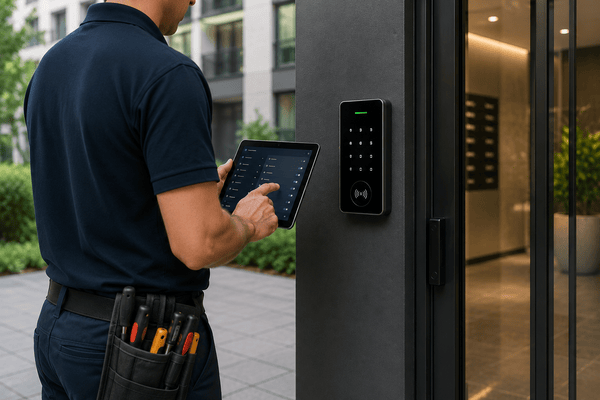
The following companies serve different parts of the Bay Area and specialize in different areas. Rather than treating one company as universally superior, we focused on documented capabilities and the types of properties each installer appears best suited to.
Elwin Security
Headquarters/service area: Santa Clara; San Francisco Bay Area
Best for: Commercial, multifamily, and mixed-use properties
Specializations: Access control, video intercom, cameras, door hardware, locks, gates, and low-voltage systems
Elwin Security is a Santa Clara-based security systems integrator that plans, installs, integrates, configures, repairs, and supports access control and related building security systems. Its published service area includes San Francisco, Oakland, San Jose, Fremont, Santa Clara, Sunnyvale, San Mateo, and other Bay Area cities.
The company takes a property-first approach, combining access control with cameras, intercoms, doors, locks, and low-voltage infrastructure. It also handles gate access systems for commercial and multifamily properties, including pedestrian and vehicle gates.
Strengths: Broad integration capabilities, Bay Area coverage, commercial and multifamily focus, and an emphasis on site-specific planning.
Limitations: Elwin’s service focus is the San Francisco Bay Area. Owners with properties outside the region should confirm coverage.
Best for: Property owners and managers looking for a Bay Area integrator to coordinate access control with door hardware, intercoms, cameras, gates, and related infrastructure.
Integrated Access Security
Headquarters/service area: Redwood City and surrounding Bay Area communities
Best for: Small businesses, enterprises, and commercial properties
Specializations: Access control, smart cards, electronic credentials, system integration, video surveillance, and security systems
Integrated Access Security (IAS) is a commercial security systems provider serving businesses in Redwood City and surrounding Bay Area communities. The company designs, installs, and integrates access control systems ranging from single-door installations to multi-system deployments.
For access control, IAS offers customized systems for businesses of different sizes, with support for smart-card credentials using HID iCLASS technology. Its broader integration capabilities include elevator controls and video verification, allowing access control to work alongside other security systems rather than operating as a standalone solution.
Strengths: Experience with both standalone and integrated access control deployments, HID iCLASS smart-card technology, and broader security-system integration capabilities.
Limitations: Property managers specifically looking to transition to a cloud-first, mobile-credential-based system should confirm which current platforms IAS supports and whether they can accommodate the desired upgrade path.
Best for: Bay Area businesses looking for a local commercial security provider that can combine access control with video surveillance and other building security systems.
Metro Electric
Headquarters/service area: San Francisco, with a South Bay office in Santa Clara
Best for: Commercial buildings and larger integrated security projects
Specializations: Access control, CCTV, intrusion alarms, structured cabling, electrical, and low-voltage systems
Metro Electric provides access control through its Communications Division, alongside electrical, structured cabling, network infrastructure, CCTV, intrusion detection, and fire/life-safety services. Its team also provides maintenance and support for low-voltage projects, giving commercial customers a single provider for multiple building systems.
The company supports access control platforms from manufacturers including Software House, Brivo, Keri, Avigilon, and Kantech. This range can give property owners more flexibility when selecting a system or integrating access control with existing security and communications infrastructure.
Strengths: Combination of electrical contracting, communications infrastructure, and security integration; support for multiple access control platforms; San Francisco and Santa Clara offices.
Limitations: Its broad electrical and communications offering may be more extensive than necessary for access-control-only projects.
Best for: Commercial property owners and larger projects that need access control coordinated with electrical, networking, CCTV, intrusion detection, or other low-voltage infrastructure.
PAC Integrations
Headquarters/service area: Concord, California; Bay Area and surrounding communities
Best for: Businesses seeking integrated security systems
Specializations: Access control, video surveillance, intrusion alarms, fire alarms, design, and monitoring
PAC Integrations provides commercial security integration, including access control, as part of a broader, multi-system security platform. Its access control solutions allow users to manage and monitor entry to sensitive areas from computers or mobile devices, while its engineering team designs systems around the customer’s environment and security requirements.
The company emphasizes customized solutions rather than standardized packages and has decades of installation experience. Its design services can coordinate access control with video surveillance, intrusion detection, fire alarms, and other security technologies. PAC also provides 24/7 monitoring for security and life-safety events.
Strengths: Integrated system design, mobile and remote access control management, multi-layer security solutions, and in-house design and installation capabilities.
Limitations: Access control is one component of a broader security offering, so buyers seeking a highly specialized access-control-only installer should confirm the company’s experience with their specific platform and project requirements.
Best for: Businesses that want access control designed as part of a broader, integrated security system.
AEC Alarms
Headquarters/service area: San Jose, California; Bay Area
Best for: Residential, commercial, and industrial properties
Specializations: Access control, smartphone credentials, proximity cards, PINs, and remote door and gate management
AEC Alarms is a San Jose-based security provider offering access control systems for residential, commercial, and industrial properties. Its access control services are built around Alarm.com, for which AEC is a dealer, and can support multiple credential types through the platform, including smartphone access, proximity cards, and unique PIN codes.
For property managers and security teams, AEC provides remote management features that allow authorized users to control doors and gates, modify access permissions, create schedules, and receive notifications about access events from a smartphone. You can assign access to specific doors and locks and adjust it as user requirements change.
Strengths: Flexible credential options, smartphone-based administration, remote door and gate control, customizable access schedules, and scalability from small to large deployments.
Limitations: AEC’s access control offering is closely integrated with its broader security services, so buyers should confirm compatibility with existing access control hardware and any third-party systems they need to retain.
Best for: Bay Area properties that prioritize remote access management and flexible credentials across residential, commercial, or industrial environments.
Choosing an Installer Is One Part of the Decision
A capable installer can help you avoid problems with doors, wiring, power, and integration. But the access control platform determines how you’ll manage your property after installation.
This is particularly important for multifamily and multi-tenant commercial properties. A modern cloud-based platform can centralize credentials, permissions, access logs, visitor entry, and management across multiple buildings, eliminating the need for administrators to manage each site independently.
Swiftlane’s cloud-based access control platform supports mobile, card, PIN, and other access methods alongside integrated video intercom and remote management.
For properties evaluating an upgrade from legacy access control, Swiftlane also supports retrofits and integrates access control with doors, garages, gates, and other entry points while maintaining centralized management.
The goal isn’t simply to find someone who can install an access control reader. It’s to choose a partner and platform that will still work for your property years after installation.
FAQs
How much does access control installation cost in the Bay Area?
Access control installation typically costs about $1,500 to $6,000 per door installed (national ranges; Bay Area labor runs higher), depending on the hardware, wiring, door conditions, credential type, and system complexity. Basic retrofits with existing wiring may fall around $1,500 to $2,500 per door, while standard cloud-based installations can run $3,000 to $5,000 and complex integrated systems $5,000 to $6,000 or more. Actual pricing varies by property and local labor rates, so a site assessment is the best way to get an accurate estimate. For a detailed breakdown of hardware, installation, software fees, and costs by building size, see our complete guide to building access control system costs.
What should I look for in an access control installer?
Look for an installer with experience in commercial or multifamily properties, appropriate California licensing, knowledge of door hardware and egress requirements, and experience with the access control platform you plan to use. Also confirm that the company provides site surveys, documentation, training, and ongoing service.
Do access control installers need a license in California?
Licensing requirements depend on the scope of work. California has several contractor classifications that can apply to different parts of an access control project, so property owners should verify the installer’s applicable CSLB license and confirm that it covers the planned work.
Do I need a permit to install an access control system in the Bay Area?
Permit requirements vary by city, building type, and project scope. Ask the installer whether the project requires building, electrical, fire, or other permits, and clarify whether the installer will obtain and coordinate them.
Can an access control installer reuse my existing wiring and hardware?
Sometimes. An installer can inspect existing readers, controllers, locks, power supplies, and cabling to determine which components are compatible with the new system and which need replacement. Reusing suitable infrastructure can reduce project costs and installation time.
Can an access control installer integrate cameras and video intercoms?
Many commercial security integrators can install or integrate access control with video surveillance, video intercoms, gates, elevators, and other building systems. If integration matters to your project, confirm which systems the installer supports and exactly what level of integration the proposal includes.
Should I choose a local access control installer or a national company?
The right choice depends on your property’s size, complexity, and service requirements. A local installer may offer strong Bay Area knowledge and faster on-site support, while a national integrator may be better suited to organizations managing larger or multi-state portfolios.